


Your Professional Full Trailers Manufacturer!
Liangshan Gongniu Auto Technology Co., Ltd. is rooted in Liangshan, China. It is a comprehensive enterprise specializing in the field of customized trailers. Its core business covers the manufacturing of multiple types of products such as container trailers, dump trailers, fuel tank trailers, and powder tank trailers. At the same time, it provides export services for second-hand commercial vehicles.
-
![3-axle Tank Full Trailer]() 3-axle Tank Full TrailerLeaf spring: 90mm*13mm*10 pcs.. Turntable: 3-row bead high-quality turntable.. Tow bar: heavy duty.. Brake: drum brake.
3-axle Tank Full TrailerLeaf spring: 90mm*13mm*10 pcs.. Turntable: 3-row bead high-quality turntable.. Tow bar: heavy duty.. Brake: drum brake. -
![3-axle Full Trailer]() 3-axle Full TrailerBuilt for construction and mining haulage, our 3-axle 30 cubic meter dump trailer offers stable 9000kg load capacity and reliable performance for daily heavy-duty bulk transport.Available in Q345B or
3-axle Full TrailerBuilt for construction and mining haulage, our 3-axle 30 cubic meter dump trailer offers stable 9000kg load capacity and reliable performance for daily heavy-duty bulk transport.Available in Q345B or -
![4-axle 40-ton Low-bed Full Trailer]() 4-axle 40-ton Low-bed Full TrailerLadder: heavy-duty mechanical ladder. Container twist lock: optional with or without. Tare weight: 9000Kg~10000Kg. Material: Q345B or Q550D or Q690D or T700. ..
4-axle 40-ton Low-bed Full TrailerLadder: heavy-duty mechanical ladder. Container twist lock: optional with or without. Tare weight: 9000Kg~10000Kg. Material: Q345B or Q550D or Q690D or T700. ..


Why Choose Us
High Quality
Relying on advanced intelligent production equipment and standardized workshops, our company has established a strict quality control system. Its products not only have high quality and high cost performance, but also have passed authoritative certifications such as SGS, ISO 9001 and CCC, ensuring compliance with international market access standards.
One-stop Service
To simplify the export process for customers, the company offers a one-stop service covering scheme design, production and manufacturing, cross-border transportation, customs declaration and clearance, significantly reducing customers' time and communication costs.
Customizable
The company takes "customization" as its core strength and can tailor semi-trailers of different loads, sizes and functions according to the differentiated demands of global customers, ranging from heavy-duty models for mines to dedicated models for urban logistics, fully meeting the needs of various scenarios.
Production Market
Our products have been widely distributed in Southeast Asia, Africa, Central Asia, the Middle East, South America and other regions. In response to the road conditions and regulatory characteristics of different markets, we provide rapid after-sales support, including spare parts supply and technical guidance.
Technical Parameters
|
Vehicle name |
2-axle full trailer |
|
Size |
6200*2550*1000mm (cargo platform height) |
|
Axle |
Fuwa or BPW or Bull* 2*13 tons |
|
Suspension |
Mechanical suspension |
|
Leaf spring |
90mm*13mm*10 pcs |
|
Tire |
8.25R20 or 295/60R22.5*8pcs |
|
Twist lock |
4 pcs |
|
Weight |
4000kg-5000kg |
|
Material |
Q345B or T700 |
|
Turntable |
3-row bead high-quality turntable |
|
Tow bar |
Heavy duty |
|
Brakes |
Drum brakes |
|
Brake valve |
KANGJIAN or JOST |
|
Color |
As request |
|
Warranty |
1 year |

Stability: The low center of gravity of the full trailer design makes it more stable in the driving process, especially in turning or complex road conditions, which reduces the risk of overturning.
Multi-point Distribution: Full trailers are suitable for transportation needs that require multi-point unloading, especially in urban distribution or short-distance transportation, and can efficiently perform multiple loading and unloading operations.
High Cargo Capacity: A major advantage of full trailers is their high cargo capacity. Because the trailer is completely supported by its wheels, it can carry considerable weight. This makes it ideal for transporting heavy goods such as machinery, construction materials, and large freight.
Simpler Coupling: Full trailers are connected using a drawbar, which makes them much easier to couple compared to semi-trailers. They can be attached to freight vehicles, such as box trucks.
Lower Cost to Procure & Maintain: Full trailers are cheaper to procure and require less frequent maintenance than their counterparts. Since they don’t feature as many complex components as semi-trailers, repair costs are also lower.
Applications Of Full Trailers
Commercial & Industrial Applications
Construction and Engineering: Full trailers are ideal for hauling heavy materials, oversized equipment, and machinery to and from construction sites.
Heavy Hauling: They are excellent for transporting large and heavy items such as steel, marbles, containers, and even multiple vehicles.
Long-Distance Cargo: The structural characteristics of full trailers make them suitable for long-distance, large-load cargo transportation.
Community & Personal Use
Moving: They are commonly used by individuals and families for moving bulky furniture, appliances, and other household goods during relocations.
Livestock and Plants: Secure and stable, full trailers can safely transport livestock and delicate plants.
Trash and Recycling: Utility trailers can serve for collecting trash or transporting materials to recycling centers.
Disaster Relief: Full trailers can quickly transport large quantities of essential supplies and goods to affected areas during disasters.


Components of Full Trailers
Chassis and Body: The frame and cargo area of the trailer, built to carry loads, which can vary in design depending on the trailer's purpose (e.g., flatbed, box body).
Axles: The axle supports the weight of your trailer. It connects the wheels and allows them to rotate, making the trailer mobile. Axles come in various configurations, such as single or tandem axles, depending on how much weight your trailer needs to carry.
Brakes: Trailer brakes are a must for safety, especially when hauling large or heavy loads. There are two main types: electric and hydraulic. Electric brakes are common for smaller trailers and are operated by the towing vehicle’s brake controller, while hydraulic brakes are often used for larger trailers.
Lights and Electrical System: Trailers need a fully functioning lighting and electrical system for safety and visibility. This includes brake lights, turn signals, and running lights. A properly wired trailer ensures that other drivers can see your signals, helping to prevent accidents.
Couplers: The coupler is the part that locks the hitch onto the trailer, securing it to the tow vehicle. It’s typically located at the front of the trailer.
Suspension System
The suspension system in a trailer works just like that in a car, absorbing shocks and vibrations from the road. This helps protect your load and ensures a smooth ride.
Wheels and Tires
The wheels and tires keep your trailer rolling and are critical for safety. Depending on your trailer’s size and the weight of your load, you’ll need tires that can handle the stress.
Fenders
Fenders are the protective coverings over the tires. They help prevent road debris from flying up and damaging the trailer or other vehicles. They also keep your trailer looking neat and tidy.
Jacks
The jack lets you lift or lower your trailer to hitch or unhitch it from your vehicle. There are manual and electric jacks, with the electric option offering greater convenience for larger trailers.
Key Differences Between Full Trailers Vs. Semi-Trailers
Connection Mode
Full trailers: Full trailers use a drawbar and coupling mechanism. This connection mode offers flexibility and stability but does require precise alignment.
Semi trailers: Semi trailers use fifth wheel coupling, offering good maneuverability and efficiency.
01
Design
Full trailer: Full trailers have both front and rear axles and a drawbar.
Semi trailers: Semi trailers do not have a front axle. The towing vehicle takes on a large portion of the towing weight.
02
Axles
Full trailers: With independent axles and a drawbar, full trailers offer excellent flexibility, stability, and even load distribution.
Semi trailers: Semi trailers have axles at the front of the trailer.
03
Applications
Full trailers: With a high level of stability, full trailers are optimal for rough terrain.
Semi trailers: Their versatility makes semi-trailers ideal for long-haul transportation.
04
Size and Capacity
Semi trailers: Semi-trailers are usually between 48 feet and 53 feet in length and 8.5 feet in width. The weight of cargo that can be handled is usually 80,000 lbs.
Full trailers: Full trailers are much shorter, usually 10 to 26 feet in length and 8.5 feet in width. The weight of cargo that can be handled is usually 26,000 pounds.
05
Packaging And Shipping
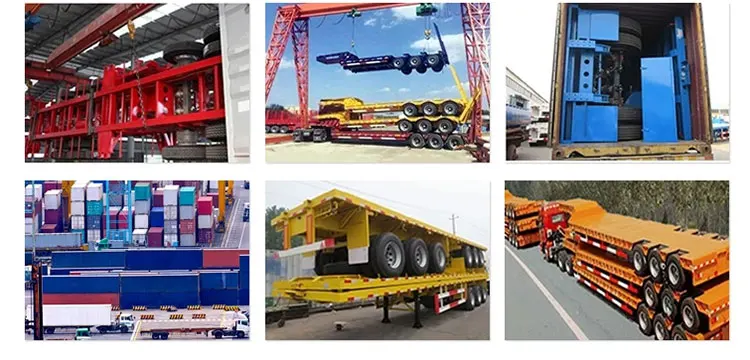
FAQ
As one of the leading full trailers manufacturers and suppliers in China, we warmly welcome you to buy high quality full trailers for sale here from our factory. Good service and reasonable price are available.
3 axle Full Trailer, 3 axle Tank Full Trailer, 2 axle Full TrailerPopular Products


